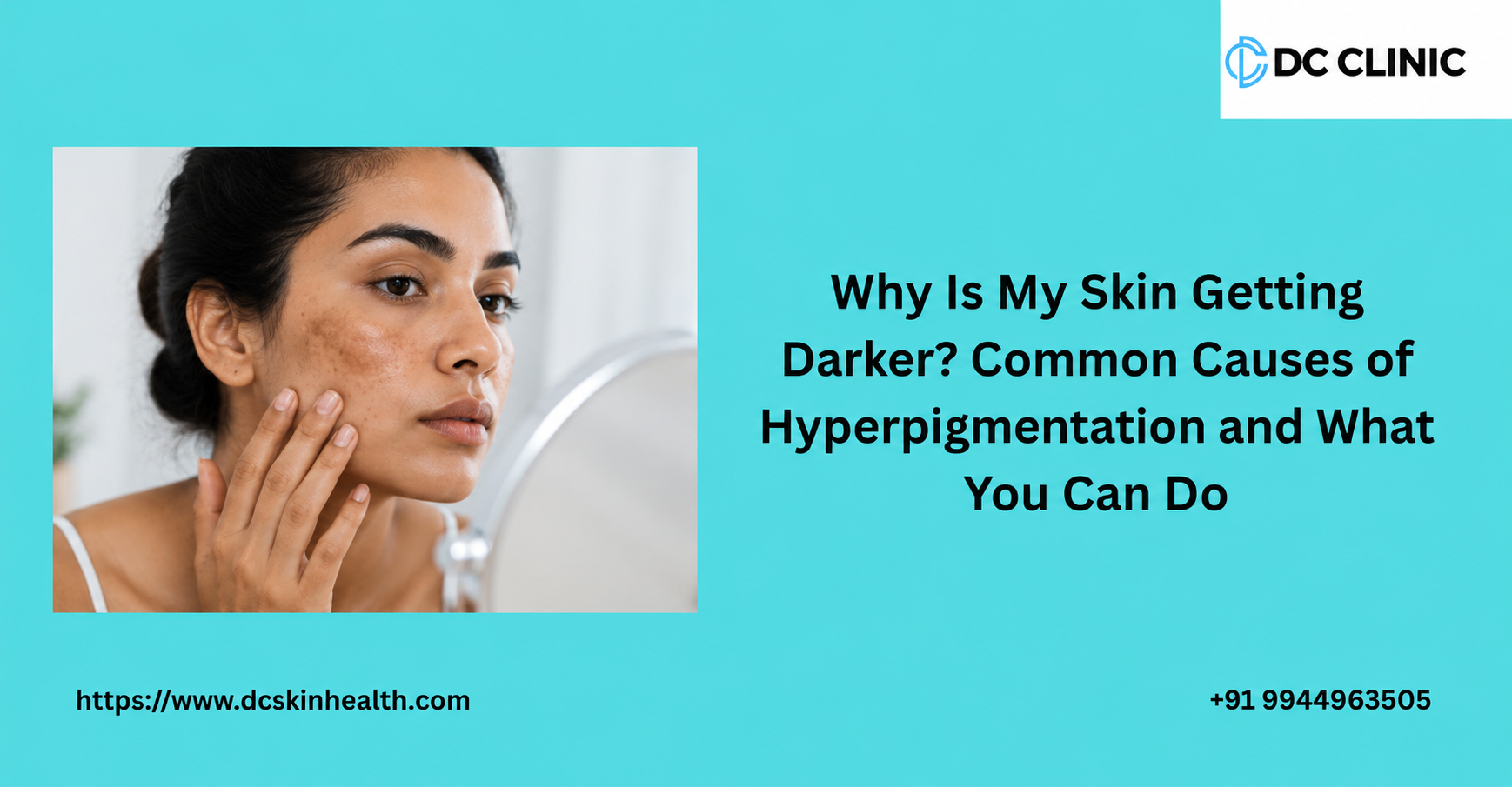
Why Is My Skin Getting Darker? Common Causes of Hyperpigmentation and What You Can Do
Written & Medically Reviewed by: Dr. Janani A Palanivel
Dermatology GP | Clinical Research Lead – Skin, Nutrition & Obesity
Core Interests: Acne, Hair & Pigmentation
Quick Answer: Hyperpigmentation occurs when certain areas of the skin develop increased pigmentation, making them appear darker than the surrounding skin. Sun exposure, hormonal changes, inflammation, acne, skin irritation and other factors can contribute to pigmentation. The right approach depends on the type and underlying cause, so persistent or recurring pigmentation should be assessed rather than treated only with lightening products.
Why Is My Skin Getting Darker?
Have you noticed that certain areas of your face or body are becoming darker than the surrounding skin?
You may see brown patches, dark spots or uneven skin tone on your cheeks, forehead, upper lip or other areas. Sometimes the pigmentation develops gradually, while in other cases it appears after acne, irritation or another skin problem.
A common question I hear is:
“Why is my skin getting darker even though I am taking care of it?”
The answer is not always as simple as using a particular cream.
Pigmentation can develop for several reasons. Sun exposure, hormonal influences, inflammation, acne, skin irritation and individual factors can all play a role. In some cases, more than one factor may be involved.
In my approach to pigmentation concerns, I believe the first step is to understand what type of pigmentation you have and what may be contributing to it. Only then can an appropriate management plan be considered.
What Is Hyperpigmentation?
Hyperpigmentation refers to areas of skin that become darker than the surrounding skin because of increased or uneven melanin production or distribution.
Melanin is the pigment responsible for much of the natural colour of our skin, hair and eyes.
When pigmentation becomes uneven, you may notice:
- Dark spots
- Brown patches
- Uneven facial tone
- Darker areas after acne or inflammation
- Pigmentation around the mouth
- Dark patches on the cheeks or forehead
Hyperpigmentation is a broad term rather than one specific skin condition.
The reason for the pigmentation matters because different types of pigmentation can require different approaches.
What Causes Hyperpigmentation?
There are several possible causes of pigmentation.
Some common contributors include:
- Sun and ultraviolet exposure
- Hormonal changes
- Melasma
- Previous acne or inflammation
- Skin irritation
- Certain medications
- Repeated friction
- Post-inflammatory changes
- Individual skin characteristics
- Certain underlying medical conditions
It is therefore important not to assume that every dark patch is simply caused by sun exposure.
1. Sun Exposure Can Make Pigmentation Darker
Sun exposure is one of the most important factors to consider when managing pigmentation.
Ultraviolet radiation can stimulate melanin production. If your skin is already prone to pigmentation, regular sun exposure may make existing dark patches more noticeable or contribute to recurrence.
This is one reason pigmentation can be particularly frustrating.
You may successfully improve the appearance of a dark patch, but repeated UV exposure can encourage pigmentation to return.
For this reason, sun protection is an important part of pigmentation management, not simply an optional addition to your skincare routine.
2. Hormonal Changes Can Contribute to Facial Pigmentation
Hormonal influences are particularly relevant to certain forms of facial pigmentation, including melasma.
Melasma commonly appears as brown or grey-brown patches, particularly on areas such as:
- Cheeks
- Forehead
- Upper lip
- Nose
Hormonal factors, sun exposure and individual susceptibility can all contribute.
Melasma can also be persistent and may recur even after improvement.
This is why treating melasma is not simply about trying to “remove” the pigment. Understanding the factors that influence it is an important part of long-term management.
3. Acne Can Leave Dark Marks Behind
If you have experienced acne, you may have noticed that the pimple disappears but a dark mark remains.
This is often referred to as post-inflammatory hyperpigmentation.
The pigmentation develops after inflammation and can be particularly noticeable in people with medium to deeper skin tones.
This is one reason I encourage patients not to focus only on the active acne.
If acne continues to occur, new inflammatory lesions can continue to produce new marks.
Therefore, managing the underlying acne and the resulting pigmentation may both be important.
4. Skin Irritation Can Cause or Worsen Pigmentation
Another commonly overlooked factor is irritation.
Aggressive scrubbing, excessive exfoliation, unsuitable products or repeated friction may irritate the skin.
Inflammation can subsequently contribute to pigmentation in susceptible individuals.
If your pigmentation became noticeable after introducing a new skincare product, undergoing an aggressive treatment or repeatedly irritating an area of skin, this history is important.
Sometimes the answer is not adding another active ingredient.
It may be necessary to reduce irritation and allow the skin barrier to recover.
5. Picking and Scratching Can Leave Dark Marks
Repeatedly scratching, picking or irritating an area can cause inflammation.
Once the inflammation settles, pigmentation may remain.
This can happen after:
- Acne
- Insect bites
- Rashes
- Minor skin injuries
- Eczema or other inflammatory skin conditions
- Picking at existing skin lesions
If you repeatedly irritate the same area, the pigmentation may continue to recur.
6. Certain Skincare Products May Not Suit Pigmented Skin
Many people with pigmentation become focused on finding the strongest possible “brightening” product.
However, stronger does not always mean better.
If a product causes burning, redness, peeling or significant irritation, continuing to use it may not be helpful.
When dealing with pigmentation, I prefer to consider the overall condition of the skin, including sensitivity, inflammation, current skincare and the likely cause of pigmentation.
A treatment plan should aim to improve pigmentation without unnecessarily creating additional irritation.
7. Pigmentation Around the Mouth Can Have Different Causes
Darkening around the mouth is a common concern.
However, pigmentation in this area can have different contributing factors.
Depending on the individual, we may need to consider:
- Sun exposure
- Irritation
- Lip products
- Repeated licking or friction
- Previous inflammation
- Hormonal factors
- Other skin conditions
This is why simply applying a generic pigmentation cream around the mouth may not address the underlying reason for the colour change.
Why Does My Pigmentation Keep Coming Back?
This is one of the most important questions to ask.
Pigmentation can recur because the factors that contributed to it may still be present.
For example:
Sun exposure → pigmentation → treatment → improvement → continued UV exposure → recurrence
Similarly:
Acne → inflammation → dark marks → new acne → new pigmentation
Or:
Skin irritation → inflammation → pigmentation → continued irritation → persistent pigmentation
This is why I often emphasize that pigmentation management is not only about lightening an existing dark patch.
It is also about identifying and managing the factors that may be causing the pigmentation to return.
Can Diet and Nutrition Affect Skin Pigmentation?
Nutrition and its relationship with skin health are areas of particular interest in my clinical and research work.
However, I would be cautious about attributing every pigmentation problem to a specific food or nutritional deficiency.
Skin pigmentation can have many causes, and dietary changes should not replace appropriate clinical evaluation.
When relevant, nutritional and lifestyle factors can form part of a broader assessment, particularly when managing chronic or lifestyle-related health and skin concerns.
I prefer an individualized approach rather than recommending restrictive diets or supplements without an appropriate reason.
Is Every Dark Patch Hyperpigmentation?
No.
A dark patch is not automatically ordinary hyperpigmentation.
Different skin conditions can cause changes in colour or texture, and some may require medical evaluation.
This is particularly important if a pigmented area:
- Appears suddenly
- Changes rapidly
- Becomes painful
- Bleeds
- Itches persistently
- Changes significantly in shape or appearance
- Looks different from your other pigmentation
If you notice a new or changing pigmented lesion, it should be appropriately assessed rather than assuming that it is simply a cosmetic pigmentation problem.
How Is Hyperpigmentation Evaluated?
When I assess pigmentation, I first try to understand what type of pigmentation is present and what may have caused it.
This may involve discussing:
- When the pigmentation first appeared
- Where it is located
- Whether it changes with sun exposure
- Previous acne or inflammation
- Hormonal history where relevant
- Current skincare products
- Previous pigmentation treatments
- Irritation or friction
- Medications
- Relevant medical history
- Lifestyle and nutritional factors where appropriate
The appearance and distribution of pigmentation can provide useful clues, but the complete history is important.
What Treatments Are Available for Hyperpigmentation?
Treatment depends on the type and underlying cause of pigmentation.
Depending on the individual case, management may include:
- Sun protection
- Appropriate topical treatments
- Management of the underlying skin condition
- Treatment of active acne or inflammation
- Selected chemical peels
- Other dermatologist-guided procedures where appropriate
- Maintenance skincare
Not every pigmentation treatment is suitable for every person.
A procedure or active ingredient that works well for one type of pigmentation may not be appropriate for another.
This is particularly important because skin irritation itself can sometimes worsen pigmentation.
Can Hyperpigmentation Be Completely Removed?
It is better to have realistic expectations.
Some forms of pigmentation can improve significantly with appropriate management, while others can be persistent or recur.
The outcome depends on factors such as:
- The type of pigmentation
- Its underlying cause
- Skin type
- Duration of pigmentation
- Sun exposure
- Whether the triggering condition is still active
- Consistency with treatment and maintenance
Rather than promising a fixed result or timeline, I prefer to explain what can realistically be expected from the individual's treatment plan.
How Can I Prevent Pigmentation From Getting Worse?
Pigmentation management is not only about treatment.
Daily habits can also matter.
Protect your skin from UV exposure
Regular sun protection is an important part of managing pigmentation.
Avoid unnecessary irritation
Do not repeatedly scrub or over-exfoliate pigmented skin.
Treat underlying acne or inflammation
If pigmentation develops after acne or inflammation, managing the underlying condition can help reduce the development of additional marks.
Be careful when introducing active ingredients
Introduce skincare products thoughtfully rather than combining several strong products at once.
Avoid picking
Repeated trauma can contribute to post-inflammatory pigmentation.
Follow a maintenance plan
Pigmentation can recur, so long-term maintenance may be important for some conditions.
When Should I See a Dermatology GP for Pigmentation?
Consider seeking professional evaluation if:
- Pigmentation continues to worsen
- Dark patches keep returning
- Over-the-counter products have not helped
- Pigmentation is affecting your confidence
- You develop pigmentation after persistent acne
- You have widespread or unexplained darkening
- A pigmented lesion changes in appearance
- You are unsure what type of pigmentation you have
A professional assessment can help distinguish between different causes and determine whether treatment is appropriate.
Pigmentation Treatment in Chennai: Why Individual Assessment Matters
If you are searching for pigmentation treatment in Chennai, it is important to understand that pigmentation is not one single condition.
At DC Clinic Jaganathapuram, Velachery, Chennai, pigmentation is one of my core clinical interests.
My approach is to first understand the type and likely contributors to the pigmentation before considering treatment.
As a Dermatology GP, I also believe that good medical care includes recognizing the limits of one's scope. When a patient requires specialist assessment, advanced investigation or tertiary-level treatment, appropriate referral is an important part of responsible care.
The aim is not simply to make the skin appear lighter.
The aim is to understand the skin concern and manage it appropriately while considering long-term skin health.
Frequently Asked Questions About Hyperpigmentation
What is hyperpigmentation?
Hyperpigmentation refers to areas of skin that become darker than the surrounding skin due to increased or uneven pigmentation. It can occur for several reasons, including sun exposure, inflammation and hormonal influences.
What causes pigmentation on the face?
Facial pigmentation can have several causes, including sun exposure, melasma, hormonal changes, acne-related inflammation, skin irritation and other individual factors.
Why does my pigmentation keep coming back?
Pigmentation may recur when the factors contributing to it—such as UV exposure, hormonal influences, inflammation or irritation—continue to be present.
Can acne cause pigmentation?
Yes. Acne-related inflammation can leave dark marks known as post-inflammatory hyperpigmentation, particularly after inflamed lesions heal.
Can sun exposure make pigmentation worse?
Yes. UV exposure can stimulate melanin production and may make existing pigmentation more noticeable or contribute to recurrence.
Can skincare cause pigmentation?
Irritating or unsuitable skincare products may cause inflammation in some individuals, and inflammation can subsequently contribute to pigmentation.
Is melasma the same as hyperpigmentation?
Melasma is a specific pigmentation condition. Hyperpigmentation is a broader term describing areas of increased or uneven pigmentation.
How long does pigmentation treatment take?
The timeline varies according to the type, cause and severity of pigmentation and the treatment used. Some pigmentation improves gradually, while certain conditions require longer-term management.
Can pigmentation be permanently removed?
Some forms of pigmentation can improve considerably, but recurrence is possible depending on the underlying cause and individual factors. Long-term maintenance may be necessary for certain conditions.
Final Thoughts From Dr. Janani A Palanivel
Pigmentation is not simply a problem of having “dark skin” in one particular area. It is a skin change that can have different causes, and identifying the cause is an important part of managing it.
In my approach, I prefer to look at the whole picture—your skin history, pigmentation pattern, sun exposure, previous inflammation, skincare routine, hormonal factors where relevant, lifestyle and nutritional considerations.
My interest in pigmentation, nutrition and chronic lifestyle-related skin concerns has reinforced for me the importance of looking beyond a single cosmetic symptom.
At the same time, I believe that treatment should remain evidence-based and individualized. Not every pigmentation problem needs the same cream or procedure, and not every dark patch should automatically be treated as cosmetic pigmentation.
If your pigmentation is persistent, worsening or unexplained, I recommend having it appropriately assessed before starting multiple treatments on your own.
Dr. Janani A Palanivel
Dermatology GP
Clinical Research Lead – Skin, Nutrition & Obesity
Core Interests: Acne, Hair & Pigmentation
DC Clinic , Chennai
Medical Disclaimer
This article is intended for general educational purposes and does not replace an individual medical consultation. Pigmentation can have different causes and treatment requirements. Any medication, skincare treatment or procedure should be considered based on an appropriate clinical assessment.
Visit DC Clinic
Address: No. 2, 3rd Cross Street, 3rd Main Road,
Jaganathapuram, Velachery, Chennai – 600 042, Tamil Nadu, India.
For pigmentation, acne, hair and other skin concerns, consult Dr. Janani A Palanivel and the team at DC Clinic.