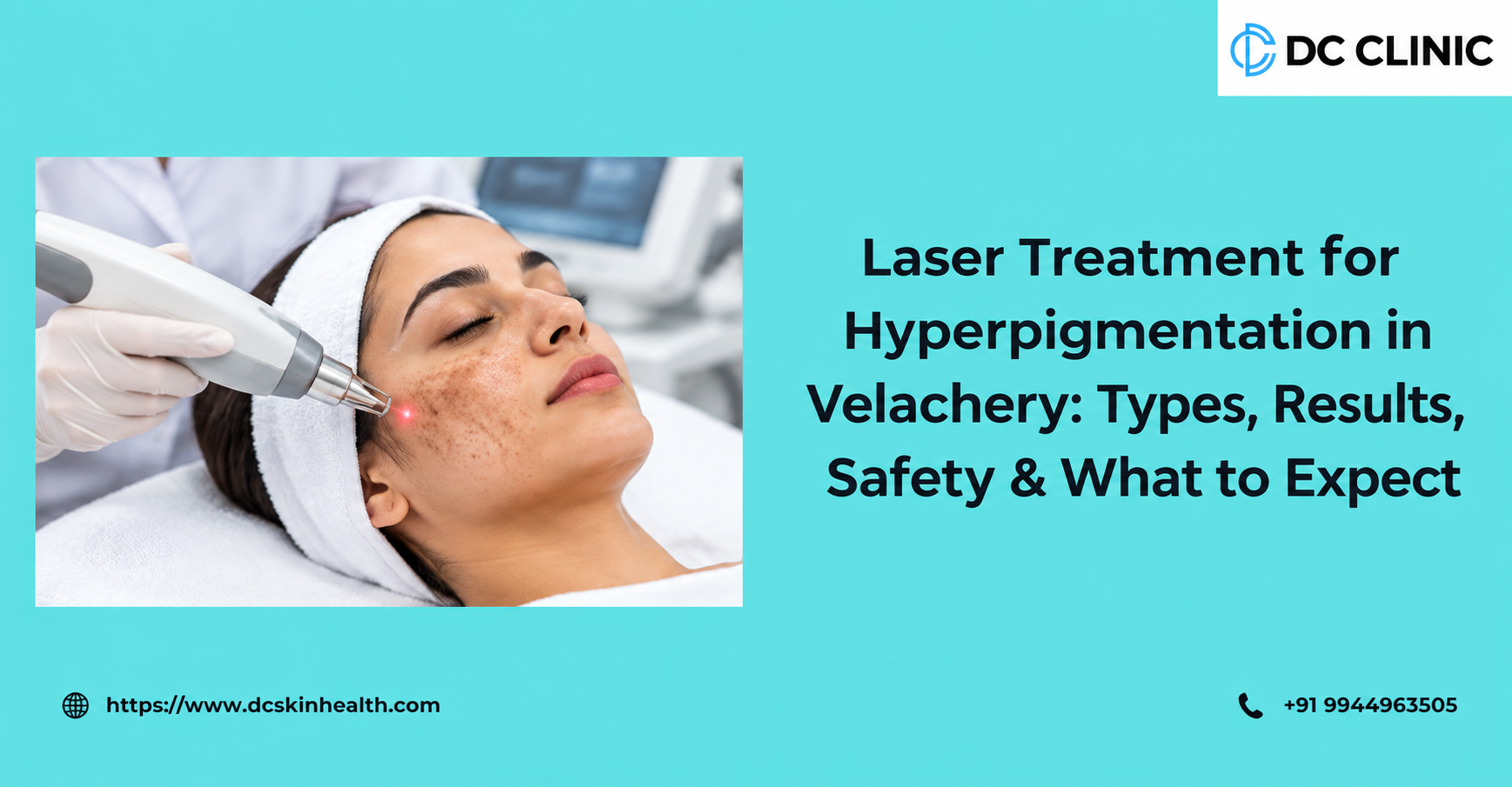
Laser Treatment for Hyperpigmentation in Velachery: Types, Results, Safety & What to Expect
Author Credentials :
Dr. Janani A Palanivel
Dermatology GP | Clinical Research Lead – Skin, Nutrition & Obesity
Core Interests: Acne, Hair & Pigmentation
Hyperpigmentation can appear as dark spots, brown patches, acne marks or an uneven skin tone. Although it is common, the reason behind pigmentation can vary from person to person. Sun exposure, acne-related inflammation, hormonal changes, melasma and skin irritation can all contribute to excess pigmentation.
If you are considering laser treatment for hyperpigmentation in Velachery, the important question is not simply which laser to choose. The first step is understanding what type of pigmentation you have, why it developed, your skin characteristics and whether laser treatment is appropriate for you.
Laser-based procedures can be useful for selected pigmentation concerns, but they are not a universal solution for every type of hyperpigmentation. A dermatologist-led assessment helps determine whether laser treatment, topical care, chemical peels, a combination approach or another option is more suitable.
At DC Skin Health Clinic, Velachery, pigmentation concerns can be assessed in the context of the individual's skin and treatment needs rather than approaching every dark spot in exactly the same way.
What Is Hyperpigmentation?
Hyperpigmentation is a darkening of the skin that occurs when an area produces or retains more melanin than the surrounding skin.
It may appear as:
- ✓ Dark spots
- ✓ Brown patches
- ✓ Post-acne marks
- ✓ Uneven facial pigmentation
- ✓ Sun-related pigmentation
- ✓ Melasma
- ✓ Post-inflammatory hyperpigmentation
- ✓ Darkened areas following skin irritation or injury
Hyperpigmentation can affect the face as well as other areas of the body. The appearance alone does not always tell you exactly why it developed, which is why identifying the underlying cause is an important part of treatment planning.
What Causes Hyperpigmentation?
Several factors can contribute to pigmentation, including:
Acne and inflammation:
Inflammation from acne can leave darker marks after the original spot has healed. This is commonly known as post-inflammatory hyperpigmentation.
Sun exposure:
Ultraviolet radiation can stimulate melanin production and may make existing pigmentation more noticeable.
Melasma:
Melasma can cause brown or greyish-brown patches, commonly on areas such as the cheeks, forehead, chin and upper lip.
Hormonal influences:
Hormonal changes can contribute to some pigmentation conditions, particularly melasma.
Skin irritation:
Repeated irritation from unsuitable skincare, excessive exfoliation or inflammation may contribute to pigmentation.
Previous skin injury or procedures:
Pigmentation can sometimes develop after an injury, burn or inflammatory skin reaction.
Understanding the cause is important because reducing visible pigmentation without addressing an ongoing trigger may not provide lasting control.
Is Laser Treatment Suitable for Hyperpigmentation?
Laser treatment may be considered for selected types of hyperpigmentation, but it is not appropriate for every pigmentation condition. The decision depends on the type and distribution of pigmentation, skin tone, treatment history and the individual's overall skin condition.
For example, isolated post-acne pigmentation may require a different approach from melasma. Some pigmentation concerns may respond better to topical treatment and sun protection, while selected patients may benefit from procedures such as laser or other dermatological treatments.
The goal should therefore be to identify the right treatment for the pigmentation, rather than choosing a laser simply because it is available.
Why Does the Cause of Pigmentation Matter?
Pigmentation is not one single condition.
Two people may both have brown patches on their face but have completely different underlying causes.
For example:
- ✓ Acne-related marks may follow previous inflammation.
- ✓ Melasma may appear as broader, symmetrical patches.
- ✓ Sun-related pigmentation may appear as individual darker spots.
- ✓ Irritation-related pigmentation may follow repeated inflammation or unsuitable skincare.
Because the causes differ, treatment selection should also differ.
This is why a professional skin assessment should come before deciding on laser treatment.
How Is Hyperpigmentation Assessed Before Laser Treatment?
A dermatologist may consider several factors before recommending a procedure.
1. Type of pigmentation
The pattern, colour and distribution of pigmentation can provide useful information about the likely condition.
2. Skin tone
Skin tone is particularly important when considering laser procedures because people with darker skin may have a greater risk of unwanted pigmentary changes following certain laser treatments.
3. Location and distribution
The location of the pigmentation can help distinguish between different concerns and may influence treatment planning.
4. Previous treatments
Previous lasers, chemical peels, prescription creams or other procedures can be relevant when deciding what should be done next.
5. Current skincare
Products containing active ingredients may affect skin sensitivity. Your dermatologist should know what you are currently applying to the treatment area.
6. Possible underlying triggers
If active acne, inflammation, sun exposure or another contributing factor is continuing, managing that issue may be an important part of pigmentation treatment.
What Types of Laser Treatment May Be Considered for Hyperpigmentation?
There is no single laser that is suitable for everyone with hyperpigmentation.
Different laser and light-based technologies work in different ways, and the choice depends on the diagnosis, skin tone, pigment characteristics and treatment objective.
Laser toning
Laser toning is one approach sometimes considered for pigmentation and uneven skin tone. Whether it is appropriate depends on the patient's condition and skin characteristics.
Pigment-targeting laser treatments
Certain laser wavelengths can interact with pigment within the skin. The appropriate technology and treatment parameters should be selected by a trained professional based on the individual's skin and pigmentation.
Other laser or light-based procedures
Depending on the condition, other technologies may also be considered.
The important point is that the machine name should not determine the treatment plan. The diagnosis and patient's skin should guide the decision.
How Does Laser Treatment for Hyperpigmentation Work?
Laser treatment uses controlled light energy to interact with targeted pigment in the skin.
Depending on the technology used, the energy may target melanin or pigmented structures, after which the body gradually processes and clears the treated pigment.
However, the process is not simply:
Laser → pigment disappears → permanent clear skin.
The response can depend on:
- ✓ Type of pigmentation
- ✓ Depth and distribution of pigment
- ✓ Skin tone
- ✓ Laser technology
- ✓ Treatment settings
- ✓ Number of sessions
- ✓ Sun exposure
- ✓ Skincare
- ✓ Whether the underlying cause is being controlled
This is why realistic expectations are an important part of the consultation.
Is Laser Treatment Safe for Indian or Darker Skin?
Laser treatment can be considered for selected pigmentation concerns in people with Indian or darker skin tones, but careful treatment planning is particularly important.
Darker skin contains more melanin, and certain laser treatments can carry a greater risk of unwanted pigmentary changes if the treatment is not appropriately selected or performed.
Possible concerns can include:
- ✓ Temporary darkening
- ✓ Lightening of the treated skin
- ✓ Burns
- ✓ Irritation
- ✓ Post-inflammatory pigmentation changes
This does not mean that laser treatment cannot be used on darker skin. It means that skin tone, diagnosis, technology and treatment settings need to be considered carefully.
If you have a darker skin tone and are considering laser treatment for hyperpigmentation in Velachery, ask your dermatologist how your skin type and pigmentation will influence the treatment plan.
What Should You Expect Before Laser Pigmentation Treatment?
A consultation is an important part of the treatment process.
Before proceeding, you should understand:
- ✓ What type of pigmentation you have
- ✓ Why it may have developed
- ✓ Whether laser is appropriate
- ✓ Which treatment technology is being considered
- ✓ What alternatives may be available
- ✓ What preparation is required
- ✓ Possible side effects
- ✓ Expected recovery
- ✓ How many sessions may be considered
- ✓ What kind of improvement is realistic
This gives you an opportunity to make an informed decision rather than choosing a procedure based only on advertisements or before-and-after photographs.
How Should You Prepare for Laser Treatment?
Preparation can vary depending on the procedure and your individual skin condition.
Your dermatologist may discuss:
- ✓ Sun exposure
- ✓ Sunscreen use
- ✓ Current skincare products
- ✓ Recent tanning
- ✓ Previous cosmetic procedures
- ✓ Active skin irritation
- ✓ Current medications
- ✓ Products that may need to be paused temporarily
Do not independently stop prescription medication or change medical treatment without discussing it with your healthcare professional.
Sun protection is especially important
If pigmentation is your concern, protecting your skin from ultraviolet exposure is important both before and after treatment.
A broad-spectrum sunscreen and appropriate sun-protection habits can help reduce additional UV-related pigmentation.
What Happens During Laser Treatment for Hyperpigmentation?
The exact procedure varies according to the laser technology being used.
Generally, the treatment area is assessed and prepared before the laser is applied.
During the procedure, you may experience sensations such as:
- ✓ Warmth
- ✓ Mild stinging
- ✓ Snapping or flicking sensations
- ✓ Temporary sensitivity
The experience can vary depending on the treatment area, technology and individual sensitivity.
Your dermatologist should explain what you can expect before the procedure begins.
Does Laser Treatment for Hyperpigmentation Hurt?
The level of discomfort varies from person to person and depends on the procedure being performed.
Some people describe laser treatment as a brief snapping or stinging sensation, while others may mainly notice warmth.
The amount of discomfort should not be the only consideration when selecting a pigmentation treatment. Correct diagnosis, safety and suitability are more important than choosing a treatment simply because it is comfortable.
What Happens Immediately After Laser Treatment?
The treated skin may temporarily appear:
- ✓ Red
- ✓ Warm
- ✓ Slightly swollen
- ✓ Sensitive
- ✓ Darker or lighter in some areas
The exact response depends on the type of procedure and individual skin characteristics.
Your dermatologist should provide specific post-treatment instructions.
Avoid introducing multiple new active skincare products immediately after a procedure unless your dermatologist specifically recommends them.
What Should You Do After Laser Pigmentation Treatment?
Aftercare is an important part of pigmentation management.
Your dermatologist may advise you to focus on:
Sun protection
Protect treated skin from unnecessary UV exposure and follow the sunscreen recommendations provided by your clinician.
Gentle skincare
Avoid unnecessary irritation while your skin is recovering.
Follow prescribed treatment
If topical medication or another treatment has been recommended, follow the instructions provided rather than changing the routine independently.
Avoid unnecessary procedures
Do not immediately combine multiple exfoliating treatments or cosmetic procedures unless they have been medically advised.
Monitor your skin
If you experience unexpected or persistent changes after treatment, contact your healthcare provider.
Why Is Sun Protection Important for Hyperpigmentation?
Sun protection is one of the most important parts of managing pigmentation.
UV exposure can stimulate melanin production and make existing pigmentation more noticeable.
For certain conditions such as melasma, visible light may also contribute to pigmentation. This is one reason dermatologists may recommend appropriate broad-spectrum sun protection as part of an overall pigmentation-management plan.
Laser treatment does not replace sun protection.
Think of pigmentation management as:
Treatment + trigger control + skin protection + maintenance
rather than relying on a procedure alone.
How Many Laser Sessions Are Needed for Hyperpigmentation?
There is no universal number of sessions that applies to everyone.
The number of treatments can depend on:
- ✓ Type of pigmentation
- ✓ Depth of pigment
- ✓ Skin tone
- ✓ Laser technology
- ✓ Treatment settings
- ✓ Response to previous treatment
- ✓ Whether underlying triggers are controlled
- ✓ Whether other treatments are being used
A responsible treatment plan should therefore be based on your individual skin rather than a fixed promise such as “X sessions for everyone.”
When Will You See Results?
Results vary between individuals.
Some pigmentation may gradually become less noticeable following appropriate treatment, while more persistent pigmentation may require a longer-term approach.
The final appearance should not be judged immediately after a procedure because the skin can temporarily change in colour or appearance during recovery.
Your dermatologist can explain what kind of improvement may be realistic based on your pigmentation and treatment plan.
Can Laser Treatment Remove Hyperpigmentation Permanently?
Laser treatment can reduce selected forms of hyperpigmentation, but permanent removal cannot be guaranteed.
Pigmentation may return if the factors contributing to it continue.
For example:
- ✓ Sun exposure may stimulate pigmentation.
- ✓ Acne can cause new post-inflammatory marks.
- ✓ Melasma can recur.
- ✓ Skin irritation may contribute to new pigmentation.
For this reason, successful pigmentation management involves more than treating existing dark spots. It also involves reducing the factors that contribute to new pigmentation.
Can Laser Treatment Make Hyperpigmentation Darker?
Yes, unwanted darkening can occur after certain laser treatments.
This is one of the reasons professional assessment is important, especially for people with medium-to-dark skin tones.
Post-treatment pigmentation changes can be influenced by:
- ✓ Skin type
- ✓ Laser technology
- ✓ Treatment settings
- ✓ Existing inflammation
- ✓ Aftercare
- ✓ Sun exposure
A stronger treatment is not necessarily a better treatment. The objective should be an appropriate treatment that balances potential benefit with safety.
Is Laser Treatment Suitable for Melasma?
Melasma requires particular consideration because it can be persistent and may recur.
Laser or light-based procedures may be considered in selected cases, but they are not automatically appropriate for every person with melasma.
Depending on the individual, management may involve a combination of:
- ✓ Sun protection
- ✓ Topical treatment
- ✓ Trigger management
- ✓ Selected procedures
If your pigmentation is symmetrical and appears as patches on areas such as the cheeks, forehead or upper lip, a dermatologist can assess whether melasma may be involved.
Laser Treatment vs Creams for Hyperpigmentation: Which Is Better?
There is no universal answer.
Topical treatment may be appropriate for some forms of hyperpigmentation, while laser treatment may be considered for selected cases.
In some situations, a combination approach may be used.
| Consideration | Laser treatment | Topical treatment |
|---|---|---|
| Treatment type | Procedure | Cream/medical skincare |
| Suitability | Depends on diagnosis | Depends on diagnosis |
| Professional assessment | Important | Important |
| Recovery | May be required | Usually differs by product |
| Results | Vary by pigmentation and treatment | Vary by pigmentation and treatment |
| Recurrence | Possible | Possible |
| Combination approach | May be considered | May be part of management |
The important question is not “Which treatment is strongest?”
It is:
“Which approach is appropriate for my type of pigmentation?”
Common Mistakes to Avoid When Treating Hyperpigmentation
1. Assuming every dark spot is the same
Hyperpigmentation can have different causes and patterns.
2. Choosing a laser before getting a diagnosis
The treatment should follow the diagnosis, not the other way around.
3. Ignoring sun protection
UV exposure can continue to stimulate pigmentation even after treatment.
4. Overusing active skincare
Too many exfoliating or irritating products can make sensitive skin more difficult to manage.
5. Expecting one treatment to solve everything
Pigmentation may require a planned treatment approach and ongoing maintenance.
6. Choosing treatment only because it is cheaper
Cost is one consideration, but treatment suitability and safety should also be discussed.
7. Comparing your results directly with someone else's
Skin type, pigmentation cause, treatment settings and individual response differ from person to person.
How Do I Choose a Laser Pigmentation Treatment Clinic in Velachery?
If you are searching for laser treatment for hyperpigmentation in Velachery, consider these questions before proceeding:
Does the clinic assess the pigmentation first?
A proper assessment can help determine whether the pigmentation is suitable for laser treatment.
Does the dermatologist explain the cause?
Understanding whether the concern relates to acne, melasma, sun exposure or another cause can influence treatment decisions.
Does the clinic consider your skin tone?
Ask how your skin type and pigmentation risk will influence treatment selection.
Are realistic results discussed?
A good consultation should include both potential benefits and limitations.
Are alternatives explained?
Laser should not automatically be recommended if another approach may be more appropriate.
Is aftercare explained?
Understanding what to do after treatment can be just as important as understanding the procedure itself.
Frequently Asked Questions
Is laser treatment good for hyperpigmentation?
Laser treatment may help selected types of hyperpigmentation, but it is not suitable for every pigmentation condition. A dermatologist should assess the cause, skin tone and characteristics of the pigmentation before recommending treatment.
What is the best laser for hyperpigmentation?
There is no single laser that is best for everyone. The appropriate technology depends on the type of pigmentation, skin tone, depth and treatment objective.
Is laser treatment safe for Indian skin?
Laser treatment can be considered for selected pigmentation concerns in Indian skin, but careful treatment planning is important. Certain procedures can carry a higher risk of pigmentary changes in darker skin.
Can laser treatment make pigmentation darker?
Yes. Pigmentary changes, including temporary or persistent darkening, can occur after some laser procedures. Appropriate treatment selection, settings and aftercare can help manage this risk.
How many sessions are needed for hyperpigmentation?
There is no fixed number of sessions for everyone. The treatment plan depends on the pigmentation type, skin tone, treatment technology and individual response.
Can pigmentation come back after laser treatment?
Yes. Pigmentation can recur because underlying triggers such as sun exposure, acne, hormonal influences or inflammation may continue.
Is laser treatment suitable for melasma?
Laser or light-based treatment may be considered in selected cases of melasma, but melasma often requires a broader management approach that may include sun protection and topical treatment.
Can laser treat post-acne pigmentation?
Laser treatment may be considered for selected post-acne pigmentation, depending on the skin and the nature of the marks. Managing active acne and preventing further inflammation may also be important.
What should I do after laser pigmentation treatment?
Follow the aftercare instructions provided by your dermatologist. Sun protection, gentle skincare and avoiding unnecessary irritation are commonly important parts of post-treatment care.
Where can I get laser treatment for hyperpigmentation in Velachery?
If you are considering treatment, a dermatologist-led consultation can help determine whether laser treatment is appropriate for your pigmentation, skin tone and individual treatment needs.
Laser Treatment for Hyperpigmentation in Velachery at DC Skin Health Clinic
If you are dealing with dark spots, post-acne pigmentation, uneven skin tone or other hyperpigmentation concerns, a professional assessment can help you understand the available treatment options and whether laser treatment may be appropriate.
Hyperpigmentation treatment should begin with understanding the pigmentation rather than immediately choosing a procedure.
At DC Skin Health Clinic in Velachery, pigmentation concerns can be evaluated based on the individual's skin, the appearance and possible cause of the pigmentation, previous treatments and the desired treatment goals.
If you are searching for laser treatment for hyperpigmentation in Velachery, schedule a professional consultation to understand your pigmentation and the treatment options that may be appropriate for your skin.
Dr. Janani A Palanivel
Dermatology GP
Clinical Research Lead – Skin, Nutrition & Obesity
Core Interests: Acne, Hair & Pigmentation
Visit DC Skin Health Clinic
No. 2, 3rd Cross Street, 3rd Main Road,
Jaganathapuram, Velachery,
Chennai – 600042.